

Real Stories Create Licensing Value
As a songwriter, your catalogue becomes valuable in sync when it carries:
- Specific emotional perspective
- Cultural identity
- Unique tone or vulnerability
- Story-driven lyrics
- A voice that feels human, not polished beyond recognition
Supervisors are responsible for protecting a project’s emotional integrity. If the song feels generic, the scene feels generic. If the song feels lived-in, the scene becomes unforgettable.
That’s why real artists still get placed.
Find out more.. our music analysis team reviews all songs in consideration and can forward pricing if we think your song is a good fit for our sync buyers.
Talent Alone Doesn’t Generate Income, cataloguing for Sync is essential..
Here’s the part most creatives don’t hear enough:
A powerful song sitting unorganized is not a sync opportunity. It’s potential.
To turn your catalogue into income, your music has to be:
- Properly registered
- Metadata complete
- Ownership splits clear
- One-stop (when possible)
- Instrumentals ready
- Clean versions available
- Professionally delivered
Supervisors don’t have time to chase down rights or guess who owns what. If it’s complicated, they move on.
Not because the song wasn’t good.
Because it wasn’t ready.
Why Professional Catalogue Management Changes Everything
Managing music from artists around the world has shown me something powerful:
Brilliant songs exist everywhere.
But the ones that get placed are the ones that are organized, positioned, and pitched intentionally.
When you work with someone who understands sync:
- Your songs are categorized by mood, tempo, and scene type
- They’re curated into targeted playlists
- They’re pitched to the right supervisors — not blasted randomly
- Your rights are protected
- Your catalogue becomes searchable and usable
You move from “artist hoping for placement” to “asset supervisors can rely on.”
That shift is what turns creativity into income.
Connection still belongs to humans…
If you’re sitting on a catalogue full of heartfelt songs and wondering how to turn them into real opportunities, the difference often isn’t in the writing.
It’s in the readiness. And when real music is properly managed, organized, and placed in front of the right people — it doesn’t compete with AI.
It stands apart.
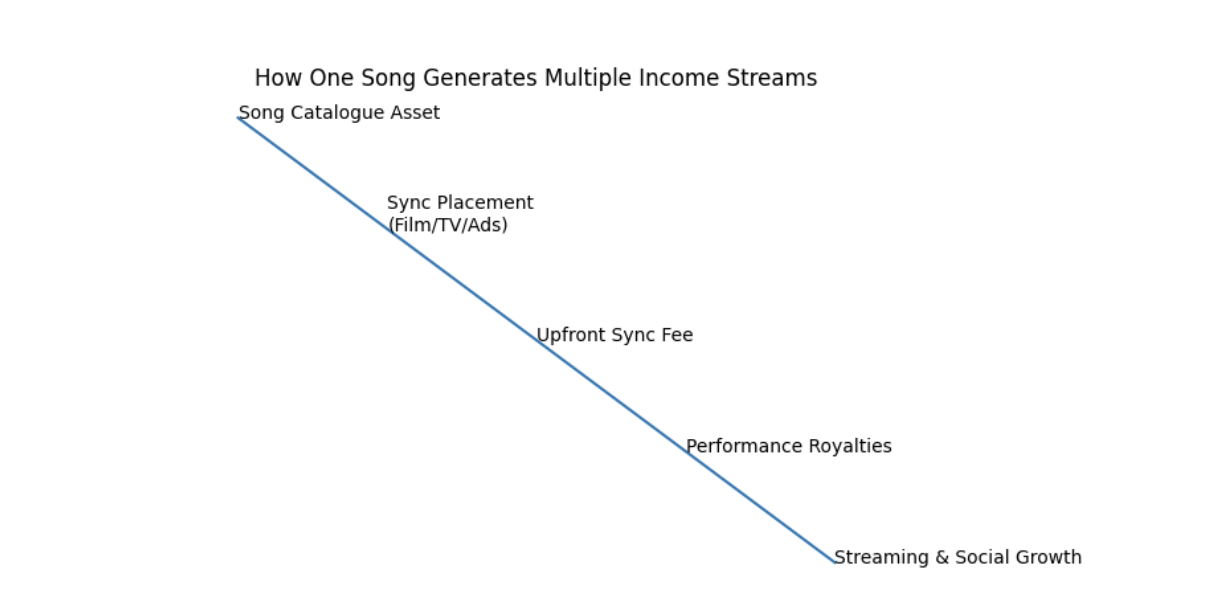
Here’s a clear, industry-focused breakdown showing exactly how songs generate income, from high-level sync placements to everyday social platforms.
This is structured in order of typical payout size and opportunity scale.
1. Film (Theatrical Releases & Streaming Films)
How income is generated:
- Upfront sync fee (for use of composition + master)
- Master use fee (recording side)
- Publishing sync fee (songwriting side)
- Backend performance royalties (through PROs when aired or streamed)
- Soundtrack album revenue (if included)
Why it pays well:
Long-term global exposure + recurring performance royalties.
2. Television (Network, Cable, Streaming Series)
How income is generated:
- Sync fee per episode
- Master + publishing fees
- Performance royalties each time it airs (domestic & international reruns)
- Streaming platform royalties
Important:
TV placements can generate ongoing backend income for years through reruns and international licensing.
3. National & Regional Commercials
How income is generated:
- High upfront sync fee
- Usage-based buyout (6 months, 1 year, territory-based)
- Renewal fees if campaign extends
- Performance royalties (depending on region and broadcast type)
Why it’s lucrative:
Commercials often pay the largest upfront fees.
4. Video Games
How income is generated:
- Sync license fee
- Buyout or term-based agreement
- Sometimes backend royalties (depends on structure)
Note:
Many games operate on buyouts, but major franchises can provide strong exposure and long-term earnings.
5. Film Trailers
How income is generated:
- Premium sync fee (often higher than film placement)
- Limited usage term (theatrical promo window)
Trailer placements can pay very well because of high promotional impact.
6. Reality TV & Docuseries
How income is generated:
- Lower upfront sync fee
- Frequent performance royalties (many re-airs)
- International distribution royalties
These placements often stack over time.
7. Social Media Advertising Campaigns
(Brand campaigns running on Instagram, TikTok, YouTube ads, Facebook)
How income is generated:
- Direct licensing fee from brand
- Territory-based campaign fees
- Duration-based contracts
Brands increasingly license indie music for digital ads.
8. YouTube Monetized Videos
How income is generated:
- Ad revenue share
- Content ID claims (if enrolled)
- Direct licensing fees (for creator usage)
- Influencer brand campaign usage
If your song is registered in Content ID, you earn revenue when others use it.
9. TikTok & Short-Form Platforms
How income is generated:
- Platform licensing deals (if distributed via aggregator)
- Creator fund participation
- Viral usage leading to streaming spikes
- Direct brand licensing
While per-use revenue is small, volume can drive substantial streaming growth.
10. Streaming Platforms (Spotify, Apple Music, etc.)
How income is generated:
- Mechanical royalties
- Performance royalties
- Master streaming revenue
- Playlist exposure → long-tail earnings
Sync placements often drive major streaming spikes.
11. Live Broadcast Events
(Sports broadcasts, award shows, televised performances)
How income is generated:
- Sync fee (if pre-cleared)
- Performance royalties from broadcast
- International PRO distributions
12. Educational & Corporate Videos
(Internal training, corporate branding films)
How income is generated:
- Direct licensing fee
- Usually buyout-based
- Non-theatrical performance royalties (sometimes)
Often steady and repeatable income source.
13. User-Generated Content (UGC)
How income is generated:
- Content ID monetization
- Platform blanket licenses
- Increased streaming from viral use
Even small creator usage can compound over time.
14. Compilation Albums & Library Licensing
How income is generated:
- Library representation fees
- Sync placements via library
- Backend royalties
- International placements
Well-organized catalogs perform better here.
The Bigger Picture: Income Stacks
A single song can generate income simultaneously from:
- A TV placement
- YouTube Content ID
- Streaming growth
- Social campaign licensing
- International reruns
- Performance royalties
This is why proper catalogue management matters.
When a song is:
- One-stop
- Properly registered
- Tagged with metadata
- Represented professionally
It becomes scalable.
The Truth About Sync Income
Most artists think sync is one big payday. In reality, it’s layered income:
Upfront fees
Backend royalties
International distributions
Streaming spikes
Content ID claims
Brand campaigns